Category: Germany

  • Hildegard Speaks

    Hildegard Speaks

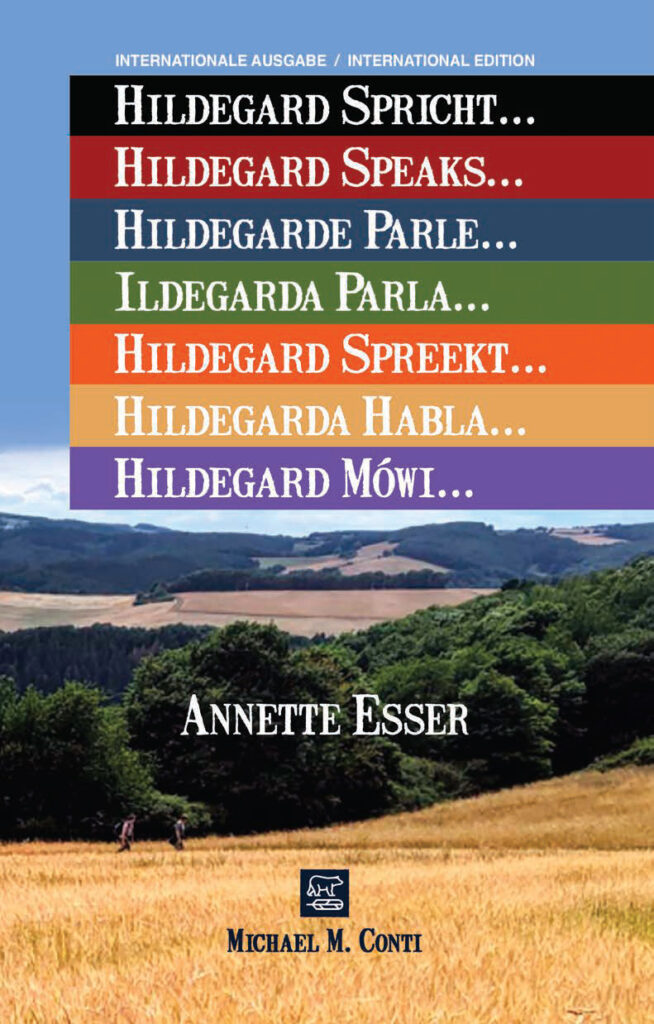
    Hildegard spricht, Hildegarde parle, Ildegada parla, Hildegard spreekt, Hildegarda habla Multilanguage Paperback

    Based on historic quotations from the writings of Saint Hildegard von Bingen (1098-1179), Dr. Annette Esser wrote these nine texts in which Hildegard, so to say, speaks herself. This well-researched multi-language book includes chapter notes, a detailed historic timeline, an illustrated color map of Hildegard Way in Germany, along with colorful images from the land of Hildegard.
    Read Aloud Hildegard Speaks


    Dr. Annette Esser is a German theologian, teacher and artist. In 2008, she founded the Scivias-Institute for Art & Spirituality. In 2017, she co-initiated the Hildegard of Bingen Pilgrimage Way along the historic sites where the Saint lived in the 12th century. She edited the 59 tableaux texts along the Way. In 2019, Dr. Esser was filmed speaking as Hildegard for nine videos. This short video series was created by pilgrim-filmmaker, Michael M. Conti, creator of The Unruly Mystic: Saint Hildegard and premiered theatrically as “Hildegard spricht” (2022) in Bad Kreuznach, Germany.

    We encourage you to read these texts out loud, hearing how Hildegard might have sounded, as you take your own pilgrimage along the Hildegard Way. The book contains the text of those presentations in German, English, French, Italian, Dutch, Spanish and Polish. We suggest doing this on the first nine stages of the Hildegard Way at the very spots which are marked by photos ahead of the nine chapters.

    All the texts start with the heading “Hildegard speaks…”

    Thus, Hildegard speaks

    1. … about precious stones and the heavenly Jerusalem
    2. … about her family and childhood
    3. … about her visions
    4. … about her art of healing
    5. … about her entrance into the Monastery of St. Disibod
    6. … about her teacher Jutta of Sponheim
    7. … about pilgrimages and her preaching tours
    8. … about how she gained fame as a seeress
    9. … about the foundation of her Rupertsberg Women’s Monastery.

    Experience a Pilgrimage with Saint Hildegard along the St. Hildegard Way in Germany.

    Dr. Esser speaks in character as “Hildegard” at 9 stations along the trail and gives a small glimpse into the many teachings of Saint Hildegard. This special ecumenical video series has been created by pilgrim-filmmaker Michael M. Conti, who took the 85-mile “Hildegard Way” through the Nahe river region in Rhineland-Palatinate in Germany.

    To conclude with Hildegard’s words: Now also you, oh human, speak out aloud about what you see and hear.

  • Saint Hildegard and the usefulness of Hops – Cheers!

    Saint Hildegard and the usefulness of Hops – Cheers!

    A Time Before Hops

    Hops weren’t always used in beer brewing—in the earliest days, brewers used all kinds of plants to flavor beer.   Generally, a beer created without the use of hops is called a ‘gruit’ or ‘grut’. ‘Gruit’ (or ‘grut’) can also be the term used for the mixture of spices working as a bittering agent in the beer.

    Some herbs commonly used in gruit:

    • sweet gale
    • mugwort
    • yarrow
    • ivy
    • horehound
    • heather
    • juniper
    • ginger
    • aniseed
    • carraway

    and really, anything else a gruit producer thought would taste good in their brew. Gruit fell out of common usage in the last century or two, but is seeing a bit of a revival these days, so there are lots of resources available like Gruit Ale and Unhopped beers website.

    But this article is about hops, not gruit,  so according to this excellent Short History of Hops by beer historian Martyn Cornell, one early mention of the usefulness of hops comes from a surprising source: Abbess Hildegard von Bingen, the German mystic whose latin texts inform some of what we know about Medieval Europe.  I

    Historical Perspective

    About 1150, Abbess Hildegard of Bingen (1098-1179), mystical philosopher and healer, published a book called Physica Sacra, which translates best as “The Natural World”. Book I, Chapter 61, “De Hoppho”, or “Concerning the hop”, says of the plant:

    “It is warm and dry, and has a moderate moisture, and is not very useful in benefiting man, because it makes melancholy grow in man and makes the soul of man sad, and weighs down his inner organs. But yet as a result of its own bitterness it keeps some putrefactions from drinks, to which it may be added, so that they may last so much longer.”

    In Physica, Hildegard described the preservative qualities of hops when added to a beverage like beer. In the same book, she also mentioned that hop increases melancholy or “back bile,” one of Hippocrates’ “four humors” of physiology; the others are man’s choleric, phlegmatic, and sanguine dispositions. Today we know that hops can relax the nervous system and thus have a calming, sedative effect, which promotes sleep. This insight made Hildegard a progressive in her time, given that her contemporaries recommended hops as a treatment for exactly the opposite affliction, depression. Hildegard also wrote extensively about barley, which she considered beneficial for the stomach and intestines; she recommended a drink made from barley as a restorative after a cold or stomach flu.

    Modern thinking

    Jay. R. Brooks of Brookston Beer Bulletin in his researched article on chasing down the origins of Hildegard being consider the patron saint of beer,  comments “If you made it through all of the accounts of her life, including her Wikipedia page, one thing you’ll notice is that none of them mention her contribution to the brewing sciences, or indeed anything about her mention of hops. That appears to be a more modern interpretation, though I’m not sure of its origin. One thing seems clear, however, and that it’s an association that here to stay.”

    German farmers were doing good business selling hops to breweries across Northern Europe by the 13th century.

    While I like the idea that Hildegard has something to do with the idea of the homeopathic benefits of using hops in beer,  her way of thinking about things continues to support the idea that she is the patron saint of creativity.   Who doesn’t want a beer after finishing their creative pursuit?  Especially one called Naughty Hildegard (tongue in cheek)?

    Naughty Hildegard ESB from the Driftwood Brewery in Victoria, British Columbia, Canada

    The Health Benefits of Beer and Hops

    Research continues to support the health benefits of beer and the moderate consumption of alcohol, including wine. Many of these health benefits are associated with hops, though some are also linked to trace elements like silicon or the affect of low-levels of alcohol.

    Healthy Hildegard gathered a few of the most well-documented health benefits of beer to help you feel better about your nightly pint.

    Hildegard von Bingen receives a vision (maybe about hops, who knows?).

    More on hops here.

  • The Hildegard of Bingen Trail in Germany

    The Hildegard of Bingen Trail in Germany

    Hildegard Pilgrimage Path

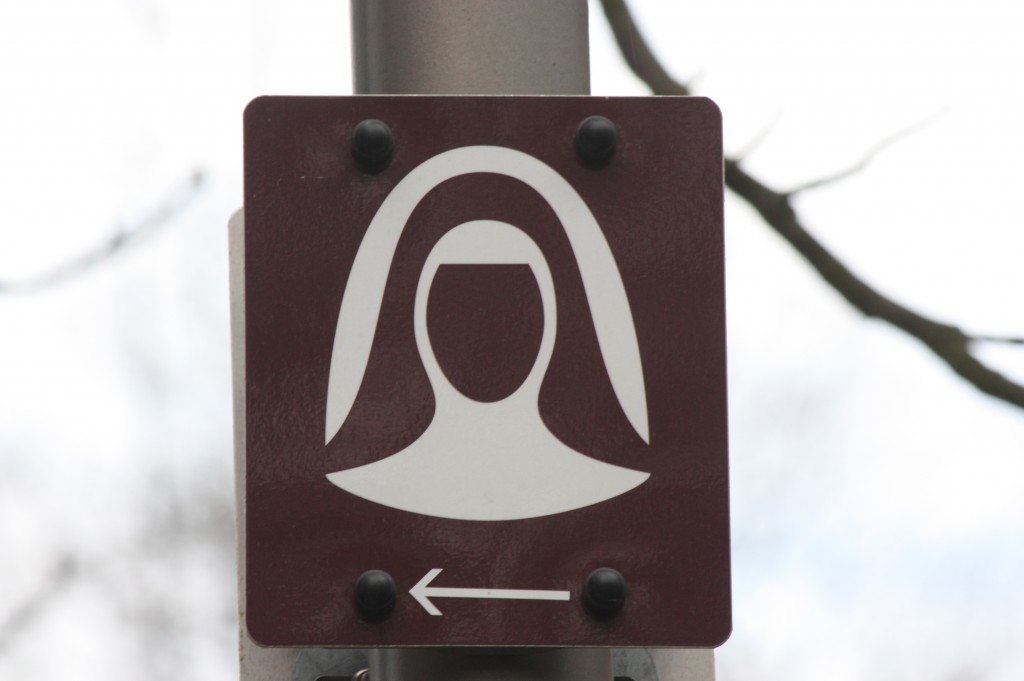
    “I love this sign, don’t you? I’ve traveled to a lot of holy places, but Bingen, Germany, is the only place where the pilgrimage route is marked by a nun sign. Hildegard is their most famous resident, and they want to make it easy for pilgrims to follow in her footsteps.

    And more people are doing just that, for Hildegard of Bingen is enjoying a surprising career resurgence for someone who’s been dead for nine centuries (for more information on her biography, see The Life of Hildegard of Bingen). Her fan club is certainly diverse: feminists hail her as a foremother, environmentalists praise her views on nature, New Age enthusiasts recognize her as a kindred spirit, and musicians record her chants (the CD A Feather on the Breath of God was a surprise best-seller in 1988). And in 2012 Hildegard was named a Doctor of the Church by Pope Benedict XVI, an honor given to only four women saints.”

    The Hildegard von Bingen pilgrimage route leads on about 135 kilometers from Idar-Oberstein to Bingen am Rhein and Rüdesheim-Eibingen through the land of Hildegard.

    Hildegardweg / Hildegard Pilgrim Path

    Itinerary program for a 8-day pilgrimage path (see map)  ~ 8-Strecken-Programm oder 8-Tage-Pilgerwanderweg (von Sonntag bis Sonntag)

    • Erste Strecke             18,7km / 4:7 Std.                                  

    Idar-Oberstein – Herrstein – Niederhosenbach – Bundenbach – Hahnenbach

    • Zweite Strecke 6,8km / 1.31 Std.                                 

    Hahnenbach – Oberhausen – Kallenfels – Bergen – Kirn – Schloss Dhaun

    • Dritte Strecke 17,7km / 3:39 Std.                               

    Schloss Dhaun – Simmertal – Bad Sobernheim – Staudernheim Disibodenberg – Odenheim/Glan

    • Vierte Strecke   12,2 km / 2:38 Std.                              

    Disibodenberg – Duchroth – Oberhausen/Nahe – Burg Schlossböckelheim – Waldböckelheim – Burgsponheim – Sponheim

    • Fünfte Strecke 9,1 km / 2:06 Std.                                 

    Sponheim – Spabrücken

    • Sechste Strecke             8,4 km / 1:48 Std.                                 

    Spabrücken – „Drei-Madonnen-Weg“ –  Schöneberg – Madonnenweg – Stromberg

    • Siebte Strecke 9,8 km / 2 Std.                                       

    Stromberg – Bingerbrück

    • Achte Strecke – ca. 5,4 km / 1:02Std.                           

    Bingerbrück – Bingen – Eibingen

    Good Reading

    I stumbled across this blog about Spiritual Travel and pilgrimage…

    Read more from Lori Erickson

    Travel writer, Episcopal deacon, and author of the Holy Rover blog at Patheos, Erickson is an engaging guide for pilgrims eager to take a spiritual journey. Her book describes travels that changed her life and can change yours, too.