Category: Germany

  • What was Saint Hildegard the Patron Saint of?  Culinary arts? Creativity?

    What was Saint Hildegard the Patron Saint of? Culinary arts? Creativity?

    Culinary arts? Creativity? The arts? The question of what Saint Hildegard is the patron saint of came up recently when I was asked where I first heard of Saint Hildegard as the Patron Saint of Creativity. In my documentary The Unruly Mystic: Saint Hildegard, I invited many of the interviewees to share whether they thought of her as the patron saint of creativity — and that framing became the gold standard in the final film. While I find it hard to believe I alone coined that phrase when I started making it, I do see that everything she did falls under what I call the pursuit of creativity.

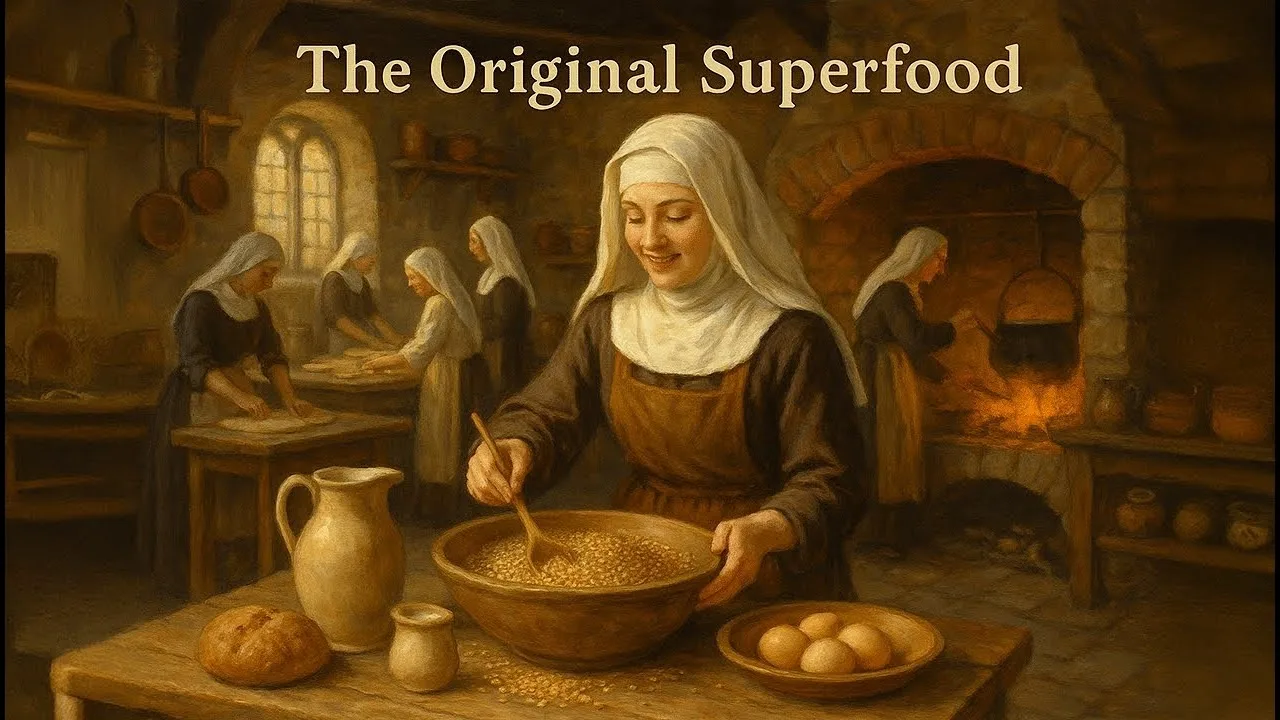
    The Loyola Press puts it plainly: “Actually she is not an official patron saint of anything — which may be a good thing, because to think of Hildegard merely as a patron saint is to gloss over her profound capabilities and influence.” And yet the same source notes that her recipe for “Cookies of Joy” is still used today, with Hildegard encouraging bakers to eat them often: “They will reduce the bad humors, enrich the blood, and fortify the nerves.” So is Saint Hildegard the patron saint of culinary arts as well? The question keeps expanding the more you look at her life.

    When you ask the question slightly differently — who is the patron saint of the arts? — you arrive at another remarkable nun, St. Catherine of Bologna. A fifteenth-century cloistered woman who lived and died in relative obscurity, she doesn’t seem the most obvious choice. Yet a closer look reveals a saint whose creative spirit, mystical visions, and struggle with doubt make her deeply relatable to artists working today. She painted, she wrote, she composed — and she did it all from inside a monastery wall.

    Scholars and religious communities have shown renewed interest in the guide she wrote for novices, The Seven Spiritual Weapons. One of those weapons might speak most directly to artists: in exhorting her sisters to trust in God, she writes, “to believe that alone we will never be able to do something truly good.” That humility — the acknowledgment that creativity flows through us rather than from us — is a posture both saints share.

    The intersection of faith and art continues to generate surprising destinations. The St. Catherine of Bologna Arts Association of Ringwood, New Jersey holds an annual exhibition called “A Little Bit of Soho in Ringwood,” timed to the weekend nearest St. Catherine’s March 9th feast day. It draws hundreds of artists and thousands of visitors. On the 600th anniversary of her birth, the theme was “Celebrating the Light That We Are” — a phrase that could as easily describe Hildegard’s entire life’s work.

    Pope Benedict spoke of St. Catherine with words that resonate equally for Hildegard:

    “From the distance of so many centuries she is still very modern and speaks to our lives. She, like us, suffered temptations — of disbelief, of sensuality, of a difficult spiritual struggle. She felt forsaken by God, she found herself in the darkness of faith. Yet in all these situations she was always holding the Lord’s hand. And walking hand in hand with the Lord, she walked on the right path and found the way of light.”

    All of which returns us to St. Hildegard as patron saint of creativity. If you are an artist, a musician, a writer, or anyone who has ever struggled to trust what you see and know — why not ask her for support in your own work?

    Here is a prayer invoking her inspiration:

    Dearest St. Hildegard, let thy gracious prayer be for this: that in all things, we serve God in bringing souls, including our own, to Him, and delightfully so. Let righteousness enfold hearts moving in and moved by the arts. Let thanks be our joyous cry, our victory shout, our honoring trumpet blast, with gratitude that our Creator gave us the sensibility to know and love Him; that He let us love as He loves, forgive as He forgives; and leads us to be as perfect in purity as He is. Actualize all our divinely-granted potential, St. Hildegard, for the chief end of uniting as the flock of our Good Shepherd, wisely using every gift He has given us. Amen.

    I would invite you to watch the film and draw your own conclusions — or better yet, let the people in it speak for themselves.
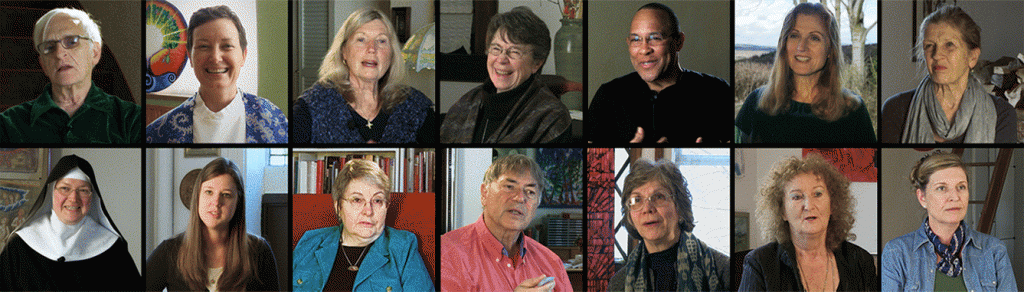
    Watch The Unruly Mystic: Saint Hildegard — who is the patron saint of creativity?
    Who is the patron saint of creativity? Watch the film and decide.
  • September 17th is the Feast Day of  St. Hildegard of Bingen

    September 17th is the Feast Day of St. Hildegard of Bingen

    Hildegard Feast Day

    Hildegard von Bingen has been venerated as a Saint in the Rhineland for centuries. Although she is listed in the Acta Sanctorum — the official Calendar of Saints in the Catholic Church — more than 800 years after her death had passed before Pope Benedict XVI officially canonized her for the whole Catholic Church on Pentecost Monday, May 10, 2012. On October 7 of the same year, also by the personal intervention of the German pope, Hildegard became the fourth woman — after Teresa of Avila, Catherine of Siena, and Thérèse of Lisieux — to be promoted as a Doctor of the Church.

    September 17th — Feast Day of Saint Hildegard

    September 17th is a special day on the Catholic Church calendar as it marks the feast day of a Doctor of the Church: St. Hildegard of Bingen. While some would like to think of her as the patron saint of creativity, the Catholic Church hasn’t made that an official acknowledgment yet — but we can hope.

    On September 17, 2013, American filmmaker Michael M. Conti was in Germany completing filming for his documentary and took part in the procession of Hildegard’s relic during her feast day. It was a remarkable experience included in the film The Unruly Mystic: Saint Hildegard.

    Hildegard Feast Day procession, September 17th
    Feast Day for Saint Hildegard of Bingen, September 17th — Catholic Calendar

    How Feast Days Are Assigned

    A saint’s feast day can be the day of their actual death or a day assigned by the Church. Typically, the Church only assigns a different day when the date of death is unknown, or when several other saints are already assigned to that day. Since the number of canonized saints exceeds the number of days in a calendar year, two or more saints often share the same feast day. When overlap occurs — or when the date of death is uncertain — another date is sometimes chosen, such as the day the saint was canonized.

  • Now more than ever relevant!

    Now more than ever relevant!

    Screenings

    Now more than ever, we all long for an order in which fairness, justice, and compassion for all people is demonstrated by our respective governments. Saint Hildegard had her own “unruly-ness” toward the powers of the Church — allowing an excommunicated nobleman to be buried in the cemetery at the convent, defying the direct orders of the Bishop of Mainz. Whose teaching was she following in taking that unruly action? That teaching is still relevant today.

    Hildegard didn’t resist quietly. When the Church threatened to place her convent under interdict — forbidding all religious services, music, and sacraments — she wrote back with fierce theological clarity, arguing that silencing sacred music was an offense against God. She won. The interdict was lifted. This was a 12th-century abbess standing her ground against the full institutional weight of the medieval Church — and prevailing.

    That combination of spiritual depth and civic courage is exactly what makes her so resonant now. She didn’t separate her inner life from her public one. Her mysticism was not a retreat from the world — it was the source of her willingness to engage it, challenge it, and demand better from it.

    Isn’t it time you became unruly? In unruliness, find your own mystic heart.

    Now More Than Ever Relevant

    Audiences everywhere are fired up by Saint Hildegard’s 12th-century activism, creativity, and ability to speak her mind across 800 years of distance. At screenings from university campuses to church halls, the conversations that follow are rarely about the past. They are about now — about power, about conscience, about what it means to trust your own perception when the world is telling you to stay quiet.

    Students in particular respond to her story with a recognition that surprises them. Here is a woman who was told, in every possible way, that her voice didn’t count — and who wrote, composed, traveled, debated, and prophesied anyway. That is not a medieval story. That is a human one.

    Students at Oxford Emory University discussing The Unruly Mystic: Saint Hildegard
    Students at Oxford Emory University — a screening of The Unruly Mystic: Saint Hildegard

    If you are interested in hosting a screening — at a university, a spiritual community, a festival, or a private gathering — get in touch. The film travels well. The conversation it starts travels even further.