Category: Beer

  • Saint Hildegard and the usefulness of Hops – Cheers!

    Saint Hildegard and the usefulness of Hops – Cheers!

    A Time Before Hops

    Hops weren’t always used in beer brewing—in the earliest days, brewers used all kinds of plants to flavor beer.   Generally, a beer created without the use of hops is called a ‘gruit’ or ‘grut’. ‘Gruit’ (or ‘grut’) can also be the term used for the mixture of spices working as a bittering agent in the beer.

    Some herbs commonly used in gruit:

    • sweet gale
    • mugwort
    • yarrow
    • ivy
    • horehound
    • heather
    • juniper
    • ginger
    • aniseed
    • carraway

    and really, anything else a gruit producer thought would taste good in their brew. Gruit fell out of common usage in the last century or two, but is seeing a bit of a revival these days, so there are lots of resources available like Gruit Ale and Unhopped beers website.

    But this article is about hops, not gruit,  so according to this excellent Short History of Hops by beer historian Martyn Cornell, one early mention of the usefulness of hops comes from a surprising source: Abbess Hildegard von Bingen, the German mystic whose latin texts inform some of what we know about Medieval Europe.  I

    Historical Perspective

    About 1150, Abbess Hildegard of Bingen (1098-1179), mystical philosopher and healer, published a book called Physica Sacra, which translates best as “The Natural World”. Book I, Chapter 61, “De Hoppho”, or “Concerning the hop”, says of the plant:

    “It is warm and dry, and has a moderate moisture, and is not very useful in benefiting man, because it makes melancholy grow in man and makes the soul of man sad, and weighs down his inner organs. But yet as a result of its own bitterness it keeps some putrefactions from drinks, to which it may be added, so that they may last so much longer.”

    In Physica, Hildegard described the preservative qualities of hops when added to a beverage like beer. In the same book, she also mentioned that hop increases melancholy or “back bile,” one of Hippocrates’ “four humors” of physiology; the others are man’s choleric, phlegmatic, and sanguine dispositions. Today we know that hops can relax the nervous system and thus have a calming, sedative effect, which promotes sleep. This insight made Hildegard a progressive in her time, given that her contemporaries recommended hops as a treatment for exactly the opposite affliction, depression. Hildegard also wrote extensively about barley, which she considered beneficial for the stomach and intestines; she recommended a drink made from barley as a restorative after a cold or stomach flu.

    Modern thinking

    Jay. R. Brooks of Brookston Beer Bulletin in his researched article on chasing down the origins of Hildegard being consider the patron saint of beer,  comments “If you made it through all of the accounts of her life, including her Wikipedia page, one thing you’ll notice is that none of them mention her contribution to the brewing sciences, or indeed anything about her mention of hops. That appears to be a more modern interpretation, though I’m not sure of its origin. One thing seems clear, however, and that it’s an association that here to stay.”

    German farmers were doing good business selling hops to breweries across Northern Europe by the 13th century.

    While I like the idea that Hildegard has something to do with the idea of the homeopathic benefits of using hops in beer,  her way of thinking about things continues to support the idea that she is the patron saint of creativity.   Who doesn’t want a beer after finishing their creative pursuit?  Especially one called Naughty Hildegard (tongue in cheek)?

    Naughty Hildegard ESB from the Driftwood Brewery in Victoria, British Columbia, Canada

    The Health Benefits of Beer and Hops

    Research continues to support the health benefits of beer and the moderate consumption of alcohol, including wine. Many of these health benefits are associated with hops, though some are also linked to trace elements like silicon or the affect of low-levels of alcohol.

    Healthy Hildegard gathered a few of the most well-documented health benefits of beer to help you feel better about your nightly pint.

    Hildegard von Bingen receives a vision (maybe about hops, who knows?).

    More on hops here.

  • What was Saint Hildegard the Patron Saint of? Culinary arts? Creativity?

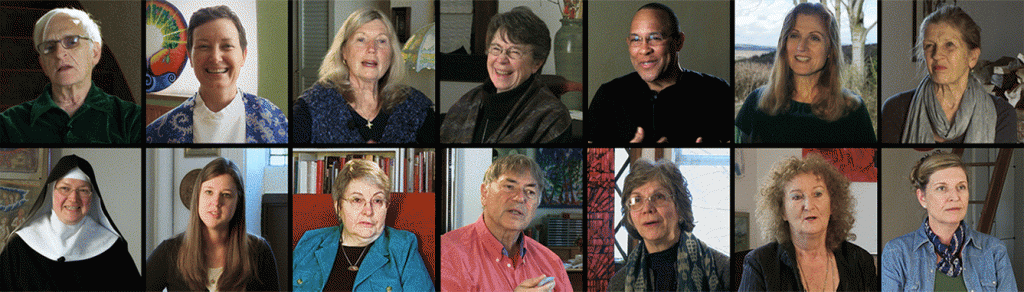
    Culinary arts?  Creativity? Arts?  This question of what was Saint Hildegard the Patron Saint of came up recently when I was asked where I had first heard or came to know Saint Hildegard as The Patron Saint of Creativity?  In my documentary of The Unruly Mystic: Saint Hildegard, I invited many of the interviewees to respond if they thought of her as the patron saint of creativity, and that became the gold standard in the final film.   While I would find it hard to believe that I alone coined that phrase at the time I started making the film,  I do see that everything she did could fall under what I call the pursuit of creativity.

    “Actually she is not an official patron saint of anything, which may be a good thing because to think of Hildegard merely as a “patron saint” is to gloss over her profound capabilities and influence” states The Loyola Press.  However the same author encourages that she should be the pantheon of other saints known for their culinary arts for  “St. Hildegard’s recipe for “Cookies of Joy” is still used today. She encouraged bakers to eat the cookies often: “They will reduce the bad humors, enrich the blood, and fortify the nerves,” she wrote.”  So is Saint Hildegard the Patron Saint of Culinary Arts too?

    While asking the question slightly differently, for instance, who is the patron saint of the arts, we get another nun a few centuries later, St. Catherine of Bologna: who was a fifteenth-century cloistered nun who lived and died in relative obscurity doesn’t seem the most obvious choice to be Patron Saint of Artists. Yet a closer look at the life of St. Catherine of Bologna shows that she is indeed a saint worthy to intercede for and inspire artists. Her creative spirit, talents, visions, and struggle with doubts make her a saint even modern-day artists can relate to.

    Scholars and religious have shown a renewed interest in the guide she wrote for novices, The Seven Spiritual Weapons. One of the “weapons” she describes in that treatise might inspire Catholic artists today: in exhorting her sisters to trust in God, she tells them, “to believe that alone we will never be able to do something truly good.”

    Along with my etsy.com example, I like how the intersection of faith and arts can lead to some surprising destinations.  St. Catherine of Bologna Arts Association of Ringwood, New Jersey holds an annual photo, art, and poetry exhibition called “A Little Bit of Soho in Ringwood.” The exhibition, held each year on the weekend nearest St. Catherine’s March 9th feast day, features hundreds of artists and draws thousands of visitors.  On the 600th anniversary of the birth of St. Catherine, the theme was “Celebrating the Light That We Are.”

    Pope Benedict recently spoke eloquently of this humble saint:

    “From the distance of so many centuries she is still very modern and speaks to our lives. She, like us, suffered temptations, she suffered the temptations of disbelief, of sensuality, of a difficult spiritual struggle. She felt forsaken by God, she found herself in the darkness of faith. Yet in all these situations she was always holding the Lord’s hand, she did not leave him, she did not abandon him. And walking hand in hand with the Lord, she walked on the right path and found the way of light.”

    All of which takes us back to St. Hildegard as being the patron saint of creativity, so what not ask that saint for support in your own work?

    Here is a prayer that I found that invokes her inspiration for one’s own creativity:

    Dearest St. Hildegard, let thy gracious prayer be for this: that in all things, we serve God in bringing souls, including our own, to Him, and delightfully so. Let righteousness enfold hearts moving in and moved by the arts. Let thanks be our joyous cry, our victory shout, our honoring trumpet blast, with gratitude that our Creator gave us the sensibility to know and love Him; that He let us love as He loves, forgive as He forgives; and leads us to be as perfect in purity as He is. Actualize all our divinely-granted potential, St. Hildegard, for the chief end of uniting as the flock of our Good Shepherd, wisely using every gift He has given us. Thanks. AMEN

    I would ask you to watch my movie yourself, and make your decision based upon what the following people have to say if you don’t trust me.

    Who is the patron saint of creativity?