Tag: spirituality

  • What Makes Someone an Unruly Mystic?

    What Makes Someone an Unruly Mystic?

    On the thread connecting Hildegard, Muir, and Einstein — and maybe you.


    People ask me why I chose the word “unruly.” It sounds almost negative — like someone who can’t sit still in class, who refuses to follow the rules, who makes trouble. And honestly? That’s exactly why I chose it.

    Hildegard von Bingen was a 12th-century abbess who composed music, wrote theology, practiced medicine, and corresponded with popes and emperors — at a time when women were expected to do none of those things. John Muir left a promising career, walked a thousand miles from Indiana to the Gulf of Mexico, and spent years living alone in Yosemite before anyone took him seriously as a voice for the American wilderness. Albert Einstein failed his entrance exam to the Swiss Federal Polytechnic, was largely ignored by the academic establishment early in his career, and developed his theory of special relativity while working as a patent clerk.

    None of them fit the mold. All of them changed the world.

    The Mystic Part

    The word mystic gets misused. People assume it means someone who floats through life in a spiritual haze, disconnected from the practical world. But every mystic I have spent time studying — through years of research, travel, and filmmaking — was fiercely engaged with reality. What made them mystics wasn’t detachment. It was depth of perception.

    Hildegard didn’t just pray — she saw. Her visions weren’t escapes from the world; they were a way of reading it more completely. Muir didn’t just hike — he listened. He heard something in the Sierra Nevada that most people walk past without registering. Einstein didn’t just calculate — he imagined. He asked what it would feel like to ride alongside a beam of light, and that question cracked open modern physics.

    The mystic is someone for whom the ordinary world is not enough — not because they reject it, but because they sense there is more to it than most people stop to notice.

    The Unruly Part

    Here is what all three of my subjects share: they refused to let the conventions of their time define the boundaries of their perception. Hildegard wrote in Latin at a time when women weren’t supposed to be theologians. Muir argued for wilderness preservation when manifest destiny was America’s operating religion. Einstein published his most radical ideas as an outsider, without the institutional backing that normally confers credibility.

    Being unruly isn’t about rebellion for its own sake. It’s about being so committed to what you genuinely see and know that you can’t pretend otherwise — even when the world would be more comfortable if you did.

    That takes a particular kind of courage. Not the dramatic, battlefield kind. The quieter, daily kind — the courage to keep trusting your own perception when everything around you is telling you to conform.

    Why It Matters Now

    I didn’t set out to make a series about historical figures. I set out to make films about a quality of aliveness that I find increasingly rare and increasingly necessary. Each generation needs to rediscover its own unruly mystics — the ones who stood strong, remained open, and stayed wide awake when the world rewarded sleep.

    Hildegard’s medicine is practiced in Europe today. Muir’s national parks are still standing. Einstein’s equations are still running. The things these people saw — really saw — turned out to be durable in ways that the conventional wisdom of their eras was not.

    That is the invitation of this series. Not to venerate historical figures from a safe distance, but to ask: what is the unruly mystic quality in your own life? Where are you being called to trust your own perception more fully — even when it’s inconvenient?

    I don’t think mystics are rare. I think they are everywhere, in various stages of becoming. The series is for them.


  • Living saints today? Have you met any?

    Living saints today? Have you met any?

    Where have all the saints gone?

    living saints
    St. Francis Hiding in the Garden

    Living saints?  Have you met any?  Not a Hindu or Catholic Saint, placed on candle-lit altar or in rose garden.  But a living saint today.  Someone who projects a oneness with the world, is filled with loving compassion, who has a purpose of being in service to others?  A humble person who is truly awake?

    I have been asking these questions, not as a religious person, but as a filmmaker who has made several films on past saints, the visionaries who woke us up like Naturalist John Muir and Mystic Saint Hildegard of Bingen; my own patron saint of creativity, has lead me to the idea who wouldn’t appreciate more saints?

    What would they look like?  Where would you meet them?  At a volunteer or charity event?  A yoga studio?  A meditation retreat?  At the office?  I bet you haven’t met a lot, if any at all.  So where have all the saints gone?  We should have more.  We have a greater population now than when historical saints lived.  We are more educated.  We have the internet of all things amazing.  So, why don’t we have more saints?  Is organized religion turning them away?  Are we treating them with antipsychotics?  Are they self-medicating with recreational drugs?

    Obviously I am not alone if you google “Where have all the saints gone?”  The question generally gets turned to who are the living saints today?  With wonderful answers from people that have meet Mother Teresa or other Sainted modern religious figures that were only officially canonized after their deaths.

    Living Saints?

    I like this comment I found:  “There are many living saints amongst us right now that we do not know of, simply because it wasn’t part of God’s will for them to be revealed to us. So it’s always good to love your neighbor, not only because we are called to do so, but also because you never know when you are talking to a saint!”

    That is so true.

    When I set out to make my films, I didn’t know at the time, that I would also be exploring that question in a more timely perspective as my subject material was historical figures that had personally inspired me and others into our live’s purposes.   “Early Christian communities venerated hundreds of saints, but historical research by 17th- and 18th-century Catholic scholars determined that very few of these saints’ stories were backed by solid historical evidence. Lives of such well-known figures as St. George, St. Valentine, and St. Christopher were based either on a legend that often predated Christianity or were entirely made up. Other saints had local followings. In rural France, St. Guinefort was venerated as the protector of infants after he saved his master’s baby from a snakebite. Saint Guinefort was a dog!” (Appeared in the November 2013 issue of U.S. Catholic (Vol. 78, No. 11, page 46).

    If you want to learn more about saints, here is a list of recommended movies about saints that I have compiled. It is primarily Catholic Saints, but obviously that isn’t the only religion that has mystics and saints walking among them.

  • The Hildegard of Bingen Trail in Germany

    The Hildegard of Bingen Trail in Germany

    Hildegard Pilgrimage Path

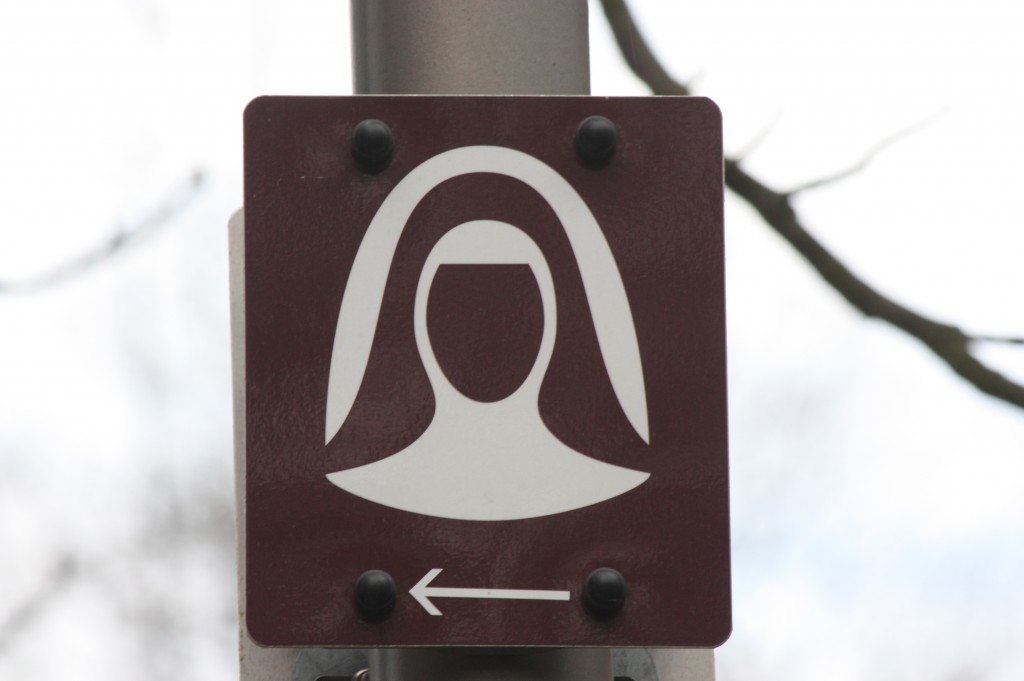
    “I love this sign, don’t you? I’ve traveled to a lot of holy places, but Bingen, Germany, is the only place where the pilgrimage route is marked by a nun sign. Hildegard is their most famous resident, and they want to make it easy for pilgrims to follow in her footsteps.

    And more people are doing just that, for Hildegard of Bingen is enjoying a surprising career resurgence for someone who’s been dead for nine centuries (for more information on her biography, see The Life of Hildegard of Bingen). Her fan club is certainly diverse: feminists hail her as a foremother, environmentalists praise her views on nature, New Age enthusiasts recognize her as a kindred spirit, and musicians record her chants (the CD A Feather on the Breath of God was a surprise best-seller in 1988). And in 2012 Hildegard was named a Doctor of the Church by Pope Benedict XVI, an honor given to only four women saints.”

    The Hildegard von Bingen pilgrimage route leads on about 135 kilometers from Idar-Oberstein to Bingen am Rhein and Rüdesheim-Eibingen through the land of Hildegard.

    Hildegardweg / Hildegard Pilgrim Path

    Itinerary program for a 8-day pilgrimage path (see map)  ~ 8-Strecken-Programm oder 8-Tage-Pilgerwanderweg (von Sonntag bis Sonntag)

    • Erste Strecke             18,7km / 4:7 Std.                                  

    Idar-Oberstein – Herrstein – Niederhosenbach – Bundenbach – Hahnenbach

    • Zweite Strecke 6,8km / 1.31 Std.                                 

    Hahnenbach – Oberhausen – Kallenfels – Bergen – Kirn – Schloss Dhaun

    • Dritte Strecke 17,7km / 3:39 Std.                               

    Schloss Dhaun – Simmertal – Bad Sobernheim – Staudernheim Disibodenberg – Odenheim/Glan

    • Vierte Strecke   12,2 km / 2:38 Std.                              

    Disibodenberg – Duchroth – Oberhausen/Nahe – Burg Schlossböckelheim – Waldböckelheim – Burgsponheim – Sponheim

    • Fünfte Strecke 9,1 km / 2:06 Std.                                 

    Sponheim – Spabrücken

    • Sechste Strecke             8,4 km / 1:48 Std.                                 

    Spabrücken – „Drei-Madonnen-Weg“ –  Schöneberg – Madonnenweg – Stromberg

    • Siebte Strecke 9,8 km / 2 Std.                                       

    Stromberg – Bingerbrück

    • Achte Strecke – ca. 5,4 km / 1:02Std.                           

    Bingerbrück – Bingen – Eibingen

    Good Reading

    I stumbled across this blog about Spiritual Travel and pilgrimage…

    Read more from Lori Erickson

    Travel writer, Episcopal deacon, and author of the Holy Rover blog at Patheos, Erickson is an engaging guide for pilgrims eager to take a spiritual journey. Her book describes travels that changed her life and can change yours, too.